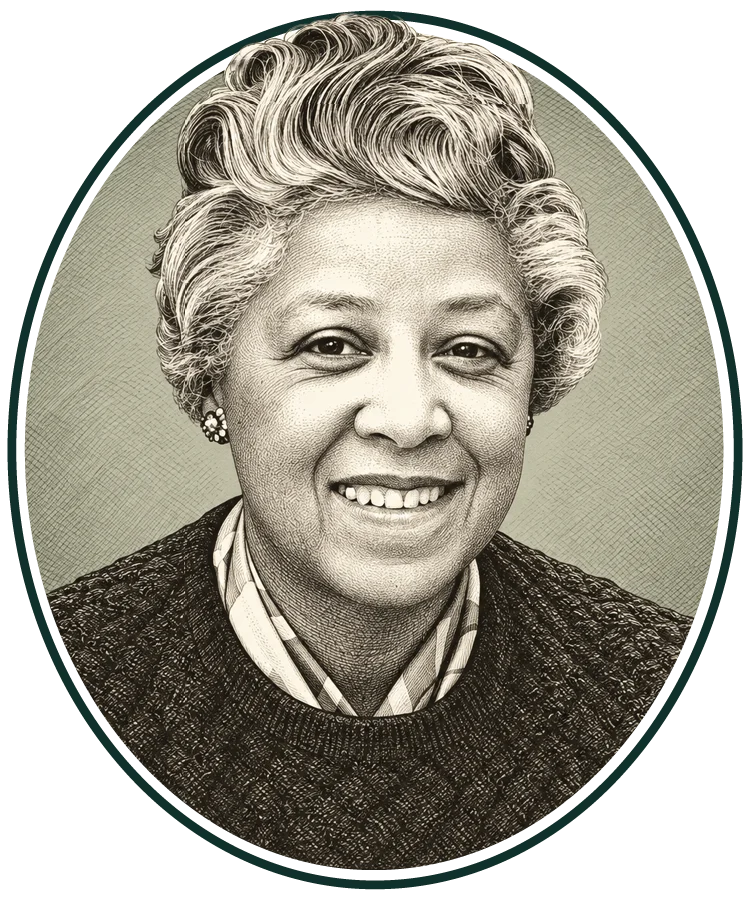
She challenged the city to change.
Virginia Keys Jones Coffey devoted much of her life to advancing racial equality in Cincinnati. As an educator, community leader, and human-relations advocate, she worked to remove discriminatory barriers in housing, employment, recreation, and public life.
Born in Wheeling, West Virginia, in 1904, Coffey moved with her family to Grand Rapids, Michigan, as a child. Her parents wanted her to attend an integrated school.
When she came to Cincinnati to teach in 1924, she encountered a city shaped by segregation. Rather than leave, she chose to work toward changing the systems around her.
She taught at the Harriet Beecher Stowe School and later became executive director of the West End YWCA, building connections between education, community support, and civil rights.
In 1948, Coffey joined the Mayor’s Friendly Relations Committee, which later became the Cincinnati Human Relations Commission.
Her work addressed racial integration, housing, employment, and access to public facilities. Her efforts contributed to the integration of Cincinnati’s swimming pools and helped challenge discriminatory practices at Coney Island amusement park.
Coffey studied laws and institutions, then worked within and alongside them to bring about change. Her approach combined persistence with a practical understanding of how local systems operated.
In 1968, Coffey became executive director of the Cincinnati Human Relations Commission, the first Black woman to hold that position.
She also helped establish Cincinnati’s Martin Luther King Jr. March alongside Rev. Damon Lynch Jr. and other local leaders. Later, she served as a human-relations consultant to the University of Cincinnati and advised communities confronting racial tensions.
Named an Enquirer Woman of the Year in 1968 and a Great Living Cincinnatian in 1993, Coffey earned recognition for decades of service. Her career demonstrates how sustained local organizing can expand access and opportunity across a city.