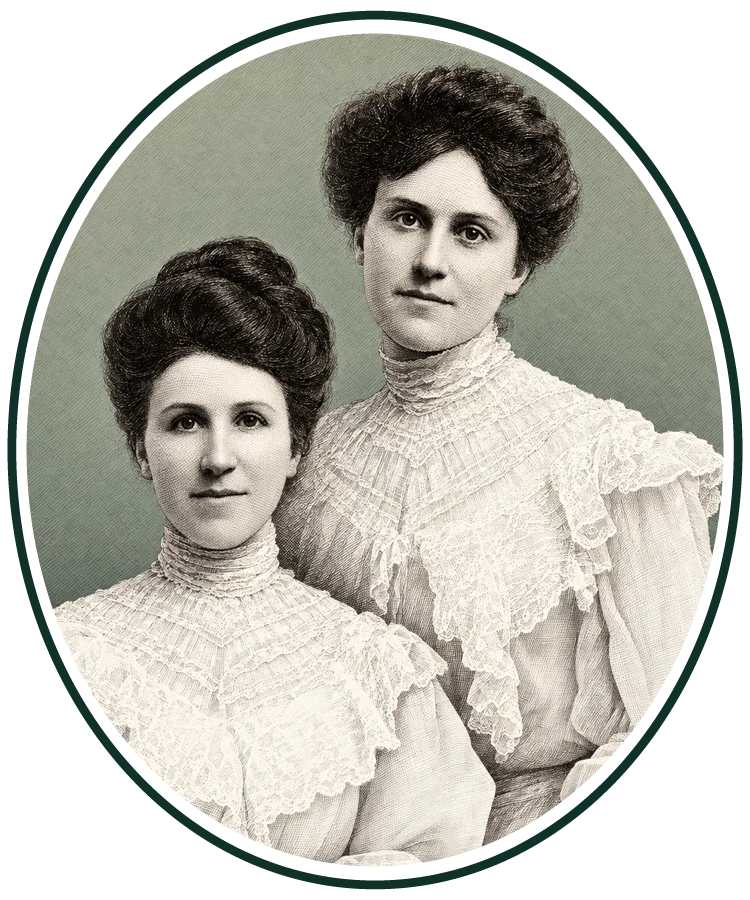
They transformed access to education in Cincinnati.
Georgia and Florence Trader were sisters whose work expanded access to books, education, and employment for blind people. From Cincinnati public schools to the founding of Clovernook, they helped create opportunities for learning and independence.
Born in Xenia, Ohio, Georgia developed severe visual impairment in infancy and later became completely blind.
When suitable educational facilities were unavailable in Cincinnati, her mother, Elizabeth, enrolled her at the Ohio Institution for the Education of the Blind in Columbus. Dissatisfied with conditions there, Elizabeth brought Georgia home and taught herself the New York Point System so she could teach her daughter to read.
With her family’s support, particularly that of her younger sister Florence, Georgia learned to roller skate, dance, sew, and play piano and cards. She attended public school alongside Florence in Walnut Hills, becoming the first blind child to attend Cincinnati public schools.
Determined to make reading more accessible, Georgia and Florence visited approximately 400 blind people in Hamilton County to demonstrate the need for services.
On March 19, 1901, they organized the Cincinnati Library Society for the Blind. The Cincinnati Public Library provided space, while the sisters raised money to purchase the first 100 books.
Their work extended beyond the library shelves. They taught raised-type reading, knitting, and sewing, and secured free streetcar transportation for blind people and their guides.
The sisters recognized that access to education needed to be accompanied by opportunities to earn a living. In 1903, they founded Clovernook as a home and training space for blind people.
With support from William A. Procter, Clovernook expanded to offer employment, weaving, and embossed-book printing. It became one of the largest publishers of raised-type materials.
By the time of the sisters’ deaths, Clovernook was printing millions of Braille pages annually. Their work connected literacy with practical opportunity, helping more people participate in education, employment, and community life.