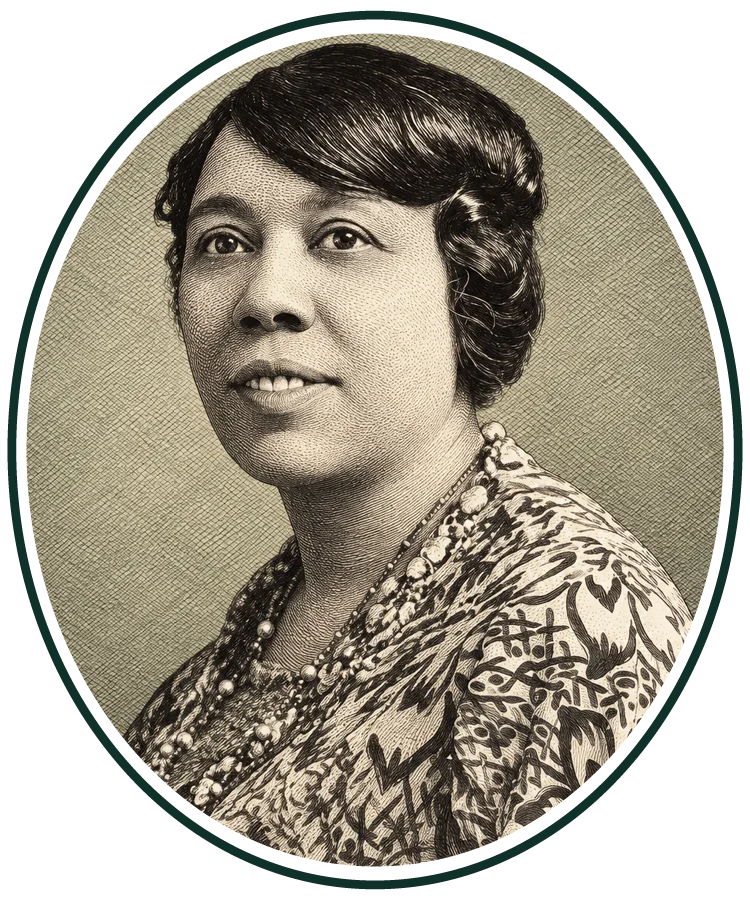
She built opportunity through education.
Jennie Davis Porter was a Cincinnati educator who devoted her career to expanding opportunities for Black children. In 1928, she became the first Black person to earn a Ph.D. from the University of Cincinnati, marking a milestone in a lifetime of teaching and community leadership.
Born in Cincinnati in 1879, Porter was the daughter of William Porter, a formerly enslaved man and prominent undertaker, and Ethlinda Davis Porter, an educator.
Following her mother into teaching, she worked at the Frederick Douglass School in Walnut Hills. As Black families arrived in Cincinnati during the Great Migration, she responded to the growing need for educational opportunities.
Porter helped establish a kindergarten for Black children and organized a summer school for children displaced by the 1913 flood.
Her work contributed to the creation of the Harriet Beecher Stowe School, where she became Cincinnati’s first Black female principal.
Under her leadership, the school offered a broad curriculum encompassing academic subjects, vocational education, music, art, and science. Health services and practical skills were also part of its approach.
Porter extended learning into community life through glee clubs, bands, and orchestras. She welcomed nationally prominent Black educators and cultural figures to Cincinnati, including Mary McLeod Bethune, George Washington Carver, and Marian Anderson.
In 1928, Porter became the first Black person to receive a Ph.D. from the University of Cincinnati.
Her dissertation argued that segregated education could benefit Black children, a position criticized by civil rights advocates, including local NAACP leader Wendell P. Dabney. Her commitment to expanding opportunity existed alongside views on segregation that conflicted with integrationist approaches.
“Take what you have and make what you want,” her motto, reflected her resourcefulness. Her legacy invites consideration of both the opportunities she created and the difficult choices Black educators faced within segregated systems.